

Why Are Weed Strains Named That? The Ultimate Guide to Cannabis Strain Names
Weed strain names can feel random—like Blue Dream, Gorilla Glue, or Wedding Cake.
Some sound relaxing. Some sound energizing. Some just sound… confusing.
So how are cannabis strains actually named—and do those names really mean anything?
The short answer: sometimes—but not in the way most people think.
And that confusion? It’s real. It’s why so many people end up guessing—or choosing products that don’t match what they actually want.
That’s exactly what we teach you to avoid.
That’s exactly what we teach you to avoid.
👉 Learn how to actually understand strains—and choose the right cannabis product inside our Medical Cannabis Class.
Weed Strain Names Explained (Start Here)
Cannabis strain names are created by breeders, growers, and brands—not by a standardized system.
That means:
There’s no official naming rulebook. No guarantee of consistency. And no requirement that a name reflects actual effects or the genetics it came from.
So while names can give clues—and if you know the breeder and genetics, they can sometimes be accurate—the name alone is not a reliable way to choose a product.
How Are Cannabis Strains Named?
Cannabis strains aren’t named using one universal system.
You can download or print this chart for personal use.
Instead, names are created by breeders, growers, and brands—each using their own approach.
Unlike cannabis labeling, which is strictly regulated at the state level, strain naming isn’t standardized or controlled.
Unlike cannabis labeling, which is strictly regulated at the state level, strain naming isn’t standardized or controlled.
That’s why names can feel inconsistent, creative, or even confusing depending on where you are, or what shop you are in.
The same type of product could be named very differently depending on who created it—and what they chose to highlight.
Here’s a simple breakdown of the most common ways cannabis strains are named (with examples of strains).
You can download or print this chart for personal use.
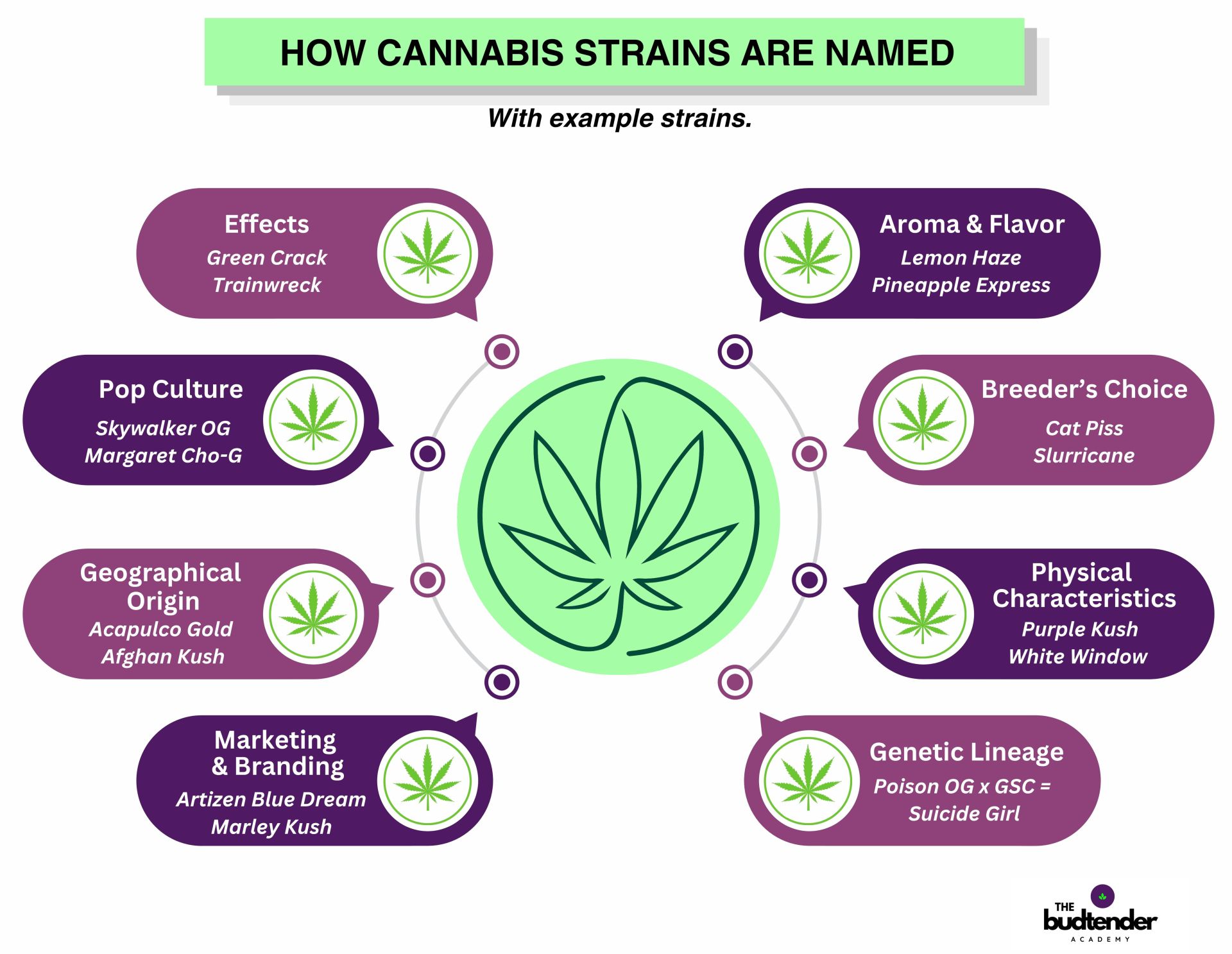
🌿 Strain names are just the starting point—learn how cannabis products can actually help you in our FREE Medical Cannabis Class.
Let’s break down a few of the most common ways cannabis strains are named—and what they actually mean.
Genetics: Where Many Strain Names Come From
Many strain names come from the plant’s lineage.
🌿 Learn how budtenders recommend strains in our FREE Medical Cannabis Class →
For example:
Blueberry + Haze → Blue Dream
Crossed strains often combine names or concepts
This can give you a hint about origin, but it doesn’t guarantee how the product will feel.
🌿 Learn how budtenders recommend strains in our FREE Medical Cannabis Class →
Effects: Names That Suggest a Feeling
Some strain names are designed to suggest effects, like:
“Dream” → calming or uplifting
“Relax” → soothing
“Diesel” → energizing or intense
But here’s the problem:
These are not standardized terms. Two products with similar names can produce completely different experiences depending on their chemical makeup.
So while names can help point you in the right direction, they’re not enough on their own—talking to a knowledgeable budtender, or relying on personal recommendations, can help you better understand how a product is likely to affect you.
🌿 You can learn how to pick out strains based on what they actually do in our FREE Medical Cannabis Class →
🌿 You can learn how to pick out strains based on what they actually do in our FREE Medical Cannabis Class →
Aroma & Flavor: Why So Many Names Sound Like Food
Terpenes Play a Role
Many cannabis strains are named after:
👉 You can learn more about how terpenes work and how they affect your experience in our terpene chart.
When the packaging actually matches the name, it’s fun, it smells amazing, and it often reminds people of flavors or foods they already enjoy.
- fruits (e.g., Strawberry Cough)
- desserts (e.g., Wedding Cake)
- candy (e.g., Zkittlez)
This naming convention based on aroma & flavor is often tied to terpenes—aromatic compounds found in cannabis (and many other plants) that influence how a product smells, tastes, and can even shape its effects.
For example:
Citrus scents → limonene
Earthy or musky → myrcene
👉 You can learn more about how terpenes work and how they affect your experience in our terpene chart.
When the packaging actually matches the name, it’s fun, it smells amazing, and it often reminds people of flavors or foods they already enjoy.
While a name might reflect aroma, it still doesn’t tell you everything about effects.
🌿 Learn how to choose the right cannabis product for your needs in our FREE Medical Cannabis Class →
🌿 Learn how to choose the right cannabis product for your needs in our FREE Medical Cannabis Class →
Marketing & Branding: Fun But Can Be Misleading
This is where things get interesting.
Cannabis strain names are often chosen to stand out on dispensary menus, sound appealing or memorable, and create a specific vibe—like Green Crack, Death Star, or Bruce Banner.
In many cases, they’re designed to make you want to buy the product because the name feels familiar—like a person, movie, song, or place.
In many cases, they’re designed to make you want to buy the product because the name feels familiar—like a person, movie, song, or place.
These names are often created for branding—not accuracy.
For example, some strains are named after famous people or cultural icons to create instant recognition—like Marley-inspired strains—while others reference movies or pop culture to feel entertaining or familiar, like Skywalker OG.
🌿 Learn how to choose the right cannabis product and how strains like Blue Dream can provide real medical benefits in our FREE Medical Cannabis Class. →
🌿 Learn how to choose the right cannabis product and how strains like Blue Dream can provide real medical benefits in our FREE Medical Cannabis Class. →
What Actually Matters When Choosing Cannabis
Instead of relying only on strain names, focus on what’s inside the product:
- Cannabinoids (THC, CBD, etc.)
- Terpenes (flavor + effects)
- Ratios (like 1:1 THC to CBD)
Dosage (how much you’re consuming):
These factors are what truly determine how cannabis will feel.
It can also help to lean on personal recommendations—from friends, family, or people you trust who have had firsthand experience. But your best resource is often the person who sees it all every day: the budtender.
They work with these products regularly, hear real feedback, and can help guide you toward something that actually fits what you’re looking for.
They work with these products regularly, hear real feedback, and can help guide you toward something that actually fits what you’re looking for.
🌿 Learn how to choose the right cannabis product for your needs in our FREE Medical Cannabis Class →


Created with